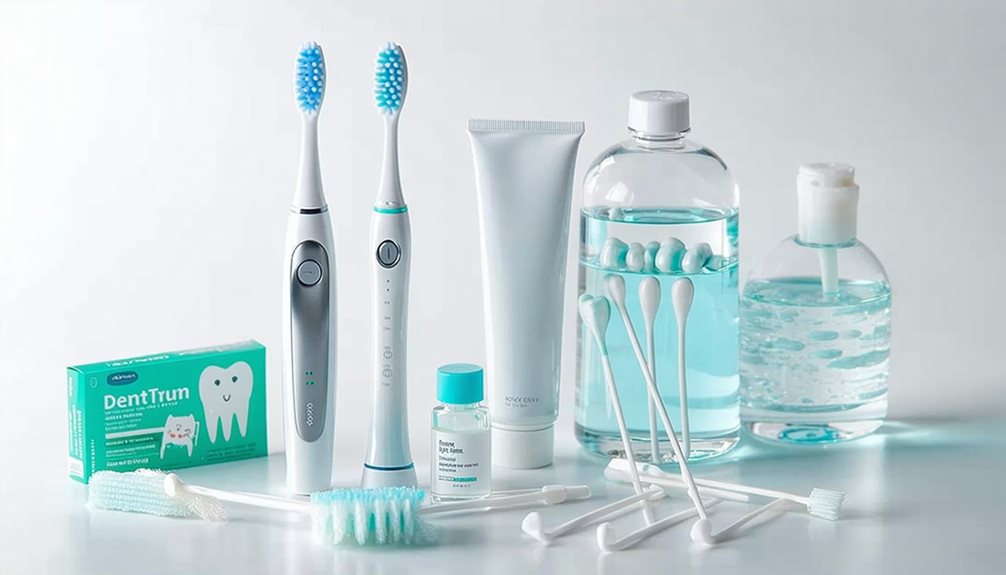
The management of gum disease is enhanced by specific dental hygiene products that target oral bacteria and improve gingival health. Antibacterial toothpastes containing triclosan or stannous fluoride are effective against pathogenic oral bacteria. Electric toothbrushes with pressure sensors and oscillating-rotating technology provide superior plaque removal. Dental floss, including PTFE and waxed varieties, plays a critical role in plaque control. Alcohol-free mouthwashes with essential oils like tea tree aid in reducing gingival inflammation. Water flossers and interdental brushes offer precision cleaning for interdental spaces. Each product is grounded in scientific evidence for efficacy, revealing further insights into thorough periodontal care.
Antibacterial Toothpastes
Antibacterial toothpastes are an integral component in the management of gum disease, offering a targeted approach to reducing pathogenic oral bacteria. These formulations are engineered to combat the microbial biofilm that contributes to periodontal inflammation. The active ingredients, often including triclosan or stannous fluoride, disrupt bacterial cell walls, effectively mitigating gingivitis risk.
Increasingly, formulations harness natural ingredients such as tea tree oil and aloe vera, providing antimicrobial efficacy without synthetic chemicals, appealing to a health-conscious demographic.
The innovation in antibacterial toothpaste extends beyond active ingredients to encompass enhanced user experience through diverse flavor options. These flavors, ranging from peppermint to more exotic variants like cinnamon and cardamom, guarantee patient compliance by catering to personal taste preferences.
This customization not only improves the sensory experience but also promotes consistent use, a critical factor in achieving ideal therapeutic outcomes.
Evidence underscores the importance of integrating antibacterial toothpastes into daily oral hygiene regimens, alongside mechanical plaque control, for thorough periodontal health.
As research advances, the development of novel formulations with natural ingredients continues to expand, offering innovative solutions for individuals seeking effective, yet gentle, management of gum disease.
Electric Toothbrushes
Electric toothbrushes have demonstrated superior efficacy in advanced plaque removal compared to manual brushing, primarily due to their oscillating-rotating and sonic technologies.
These devices are also equipped with gum sensitivity features such as pressure sensors and adjustable intensity settings, which are critical for patients with periodontal disease.
Clinical studies underscore their ability to reduce gingival inflammation and enhance overall periodontal health by promoting ideal oral hygiene practices.
Advanced Plaque Removal
Regularly advancing in oral healthcare technology, electric toothbrushes represent a pivotal tool in the effective removal of dental plaque, especially for patients suffering from gum disease. The mechanical action and high-frequency oscillation of these devices are clinically proven to offer superior plaque fighting capabilities compared to manual brushing.
Their efficacy lies in their ability to disrupt plaque buildup, reaching areas that are otherwise challenging to clean, thereby reducing the risk of plaque-induced periodontal diseases.
Electric toothbrushes are engineered with advanced features such as oscillating-rotating and sonic technologies, which enhance their plaque removal efficiency. Oscillating-rotating brushes, for instance, employ a combination of rotation and pulsation to dislodge plaque biofilm more effectively.
Meanwhile, sonic toothbrushes vibrate at high frequencies to agitate fluids between teeth, ensuring thorough cleaning even in interdental spaces. These innovations in plaque control are integral for patients seeking to mitigate the progression of gingival inflammation and periodontal pocket formation.
Moreover, the incorporation of smart technology in some electric toothbrushes allows for real-time feedback and personalized brushing experiences. This, in turn, empowers users to optimize their oral hygiene practices, thereby greatly contributing to the management and prevention of gum disease through advanced plaque removal.
Gum Sensitivity Features
Addressing gum sensitivity is crucial for patients with gum disease, and modern electric toothbrushes are equipped with features specifically designed for this purpose.
These advanced devices incorporate technology that not only enhances oral hygiene but also provides targeted gum care and sensitivity relief. By utilizing pressure sensors, customizable modes, and specialized brush heads, electric toothbrushes offer a sophisticated solution for maintaining peak gum health.
The following features highlight the innovative advancements in electric toothbrushes aimed at gum sensitivity:
- Pressure Sensors: Automatically reduce brushing intensity when excessive force is detected, protecting sensitive gum tissues from damage.
- Customizable Modes: Provide options such as "sensitive" or "gum care" modes, allowing individuals to personalize their brushing experience according to their specific oral health needs.
- Specialized Brush Heads: Designed with soft bristles and contoured shapes, these heads guarantee gentle yet effective cleaning around delicate gum areas.
- Timed Brushing Cycles: Encourage thorough cleaning by signaling when to move to different quadrants of the mouth, preventing over-brushing of sensitive areas.
- Sonic Technology: Facilitates micro-bubble generation that reaches deep between teeth and along the gumline, enhancing plaque removal while minimizing irritation.
Incorporating these features, modern electric toothbrushes cater to the needs of individuals seeking advanced, evidence-based approaches for gum sensitivity relief.
Dental Floss for Gums
Effective management of gum disease necessitates the utilization of appropriate dental floss, with particular emphasis on the types best suited for individual patient needs and specific periodontal conditions.
Research indicates that unwaxed floss, polytetrafluoroethylene (PTFE) floss, and woven floss offer distinct advantages in plaque removal and interproximal cleaning efficiency.
Mastery of proper flossing techniques, including the C-shape method and gentle sliding motions, is critical to optimizing gingival health and minimizing trauma to periodontal tissues.
Best Floss Types
Choosing the ideal dental floss type is essential for managing and preventing gum disease, a pervasive oral health issue. With a plethora of floss alternatives available, selecting the most effective type can be challenging.
However, the effectiveness of flossing is often overshadowed by prevalent flossing myths. Understanding the characteristics of each floss type can enhance dental hygiene routines and mitigate periodontal concerns.
-
Waxed Floss: Coated with a thin layer of wax, this type glides smoothly between tight teeth and is less prone to shredding, offering an efficient way to remove interdental plaque.
-
Unwaxed Floss: Made of thin nylon, it provides better tactile sensation, allowing users to feel the teeth’s surfaces, though it may fray between closely spaced teeth.
-
Polytetrafluoroethylene (PTFE) Floss: Known for its non-stick properties, PTFE floss slides easily between teeth and resists tearing, making it suitable for those with tight dental contacts.
-
Dental Tape: Broader and flatter than traditional floss, dental tape is ideal for individuals with larger gaps between teeth or those new to flossing.
-
Biodegradable Floss: Made from sustainable materials, this eco-friendly option appeals to environmentally conscious users, aligning dental care with sustainability goals.
Selecting the right dental floss is a pivotal step towards innovative and effective gum disease management.
Flossing Techniques Explained
Mastery of flossing techniques is essential for enhancing dental hygiene and preventing gum disease. Proper techniques in flossing not only remove plaque biofilm effectively from interdental spaces but also stimulate gingival tissues, contributing to overall periodontal health. Flossing benefits are maximized when executed with precision; hence, adopting an innovative approach towards technique refinement is vital.
Research underscores the importance of employing a ‘C-shape’ flossing method. This entails curving the floss around each tooth and gently sliding it under the gumline, facilitating ideal removal of interdental debris. By executing this technique, patients can achieve superior plaque control compared to traditional linear floss movements.
Additionally, the utilization of advanced dental flosses, such as those with microtextured fibers, enhances the mechanical disruption of microbial colonies, further boosting oral health outcomes.
Evidence suggests that integrating such proper techniques into daily oral care routines can greatly reduce the incidence of gingivitis and periodontitis. As dental professionals advocating for progressive healthcare, it is imperative to educate patients on these evidence-based methodologies.
Mouthwashes for Gum Health
Mouthwashes play a significant role in the management of gum health by targeting the bacteria responsible for periodontal disease. As dental professionals seek innovative solutions, the emergence of mouthwashes with natural ingredients and alcohol-free options offers substantial promise.
These formulations provide antimicrobial efficacy without the adverse effects associated with traditional alcohol-based rinses. Essential oils, such as tea tree oil and eucalyptus, are frequently employed for their potent antibacterial properties, creating an environment that hinders pathogenic colonization.
Utilizing mouthwashes as part of a detailed oral hygiene regimen can lead to improvements in gingival inflammation and periodontal pocket depth. Scientific studies have demonstrated that consistent use of these therapeutic rinses can reduce plaque biofilm, a vital contributor to gingivitis and periodontitis progression.
Clinical trials continue to evaluate the long-term benefits of incorporating these products into daily oral care routines.
Consider these innovative mouthwash features for gum health:
- Natural ingredients: Harnessing botanical extracts for antimicrobial action.
- Alcohol-free options: Minimizing oral tissue irritation while maintaining efficacy.
- Essential oils: Providing a natural, therapeutic alternative to synthetic agents.
- Plaque reduction: Targeting biofilm accumulation effectively.
- Gingival improvement: Supporting healthier gums with reduced inflammation.
These advancements in mouthwash formulations represent a substantial stride towards optimized periodontal health management.
Water Flossers
For many individuals, water flossers have emerged as a vital component in enhancing oral hygiene practices, specifically targeting interdental cleaning where traditional flossing sometimes falls short. These devices employ a pulsating stream of water to dislodge plaque and food particles from areas that are often inaccessible with conventional dental floss.
The primary water flosser benefits include effective reduction of gingival inflammation and bleeding, which are essential factors in managing periodontal disease. Clinical studies have demonstrated that water flossers can remove up to 99.9% of plaque biofilm, a notable improvement over manual flossing methods.
When conducting water flosser comparisons, it is important to evaluate factors such as water pressure settings, design ergonomics, and reservoir capacity. Advanced models offer adjustable pressure settings, catering to sensitive gums while providing robust cleaning capabilities.
Additionally, the ease of use and ergonomic design allow for a comfortable experience, promoting consistent use amongst patients. Water flossers have been shown to enhance patient compliance due to their convenience and efficiency, thereby playing a vital role in innovative dental care.
As gum disease remains a prevalent issue, incorporating water flossers into daily oral hygiene regimens can greatly aid in its prevention and management.
Interdental Brushes
Interdental brushes, an essential tool in periodontal care, offer a targeted approach to cleaning between teeth, especially in spaces that are too wide for conventional dental floss. These brushes are particularly effective in disrupting and removing plaque biofilm, a primary etiological factor in gum disease.
Interdental brush types vary in size and flexibility, allowing customization to individual patient needs and specific interdental spaces. The use of interdental cleaning techniques can considerably reduce gingival inflammation and periodontal pocket depths, enhancing oral health outcomes.
The selection of an appropriate interdental brush type depends on the anatomical characteristics of the interdental spaces and the presence of periodontal pathology. Clinicians should guide patients in selecting the correct size to guarantee efficacy and prevent trauma to the interdental papillae.
Regular incorporation of interdental brushes into oral hygiene routines can facilitate ideal plaque control and prevent the progression of periodontal disease.
- Variety of sizes: Accommodates different interdental gap widths.
- Flexible handles: Improves access to posterior teeth.
- Enhanced plaque removal: Compared to traditional flossing.
- Reusable designs: Economical and environmentally friendly.
- Clinical proof: Shown to reduce gingival bleeding indices.
Incorporating interdental brushes into daily oral hygiene regimens represents an innovative strategy for managing periodontal health effectively.
Frequently Asked Questions
Can Certain Foods Help Improve Gum Health Naturally?
Certain foods can enhance gum health by acting as natural remedies. Incorporating dietary changes, such as increased intake of omega-3 fatty acids, vitamin C-rich fruits, and fiber-rich vegetables, supports periodontal health through anti-inflammatory and antioxidant properties.
How Often Should I Visit the Dentist for Gum Disease?
For ideal management of periodontal health, it is recommended to schedule dentist frequency visits every three to six months. Regular gum disease checkups allow for early detection and innovative interventions, ensuring effective treatment and prevention strategies.
Are There Specific Vitamins Beneficial for Gum Health?
Specific vitamins, such as Vitamin C and D, are beneficial for gum health. Vitamin sources include citrus fruits and fortified dairy. Supplement benefits include enhanced collagen synthesis and immune function, promoting innovative periodontal health strategies in clinical settings.
What Are Common Symptoms of Early-Stage Gum Disease?
Early-stage gum disease, or gingivitis, commonly presents with symptoms such as gingival inflammation, bleeding upon probing, and persistent halitosis. Maintaining ideal oral hygiene is essential to prevent progression, necessitating innovative strategies for effective plaque control and periodontal health.
Is It Possible for Gum Disease to Affect Overall Health?
Gum disease connections to systemic health implications are well-documented. Research indicates potential links between periodontal disease and conditions such as cardiovascular disease, diabetes, and respiratory infections, emphasizing the need for innovative approaches in dental care to mitigate these risks.
Conclusion
In summary, ideal management of gum disease necessitates an integrative approach employing various dental hygiene products. Antibacterial toothpastes and electric toothbrushes enhance plaque control and bacterial reduction. Dental floss and interdental brushes facilitate interdental plaque removal, essential for gum health. Mouthwashes containing antimicrobial agents further support gingival health through chemical plaque control. Water flossers complement these tools by enhancing interdental cleaning. Collectively, these products represent an all-encompassing strategy for effective gum disease management, grounded in clinical and evidence-based practices.