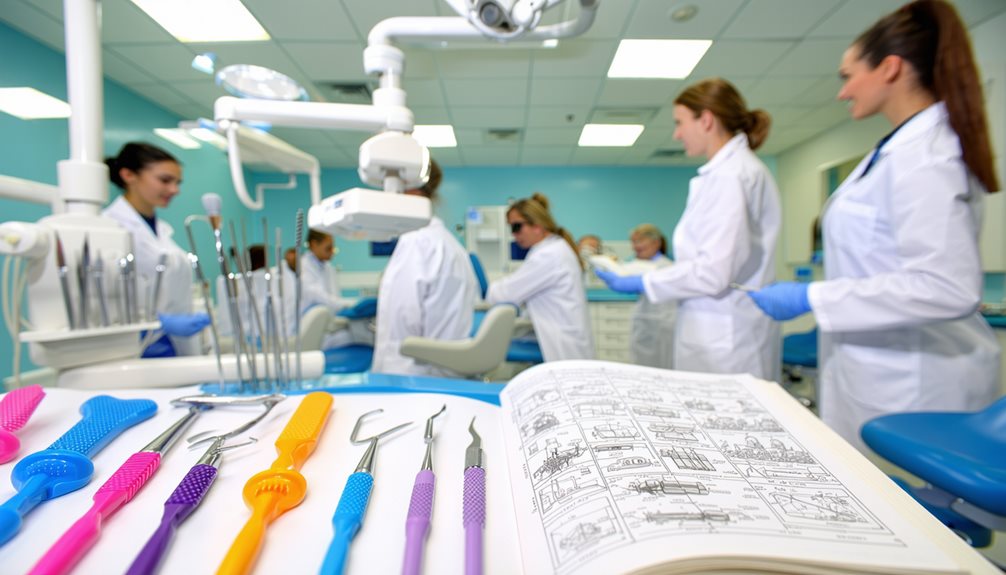
Top dental hygiene certification programs guarantee high standards in patient care and professional skill enhancement. Programs at prestigious institutions like the University of Southern California and University of Michigan offer extensive curricula that incorporate the latest research and technological advancements. When choosing a program, consider factors such as alumni success, faculty expertise, curriculum quality, and program flexibility. Financial aid options, including scholarships and grants, can ease the cost of education. The decision between online and on-campus programs hinges on personal learning styles and career goals. Exploring these renowned programs paves the way for a fulfilling career in dental hygiene.
Importance of Certification Programs
Certification programs in dental hygiene play a vital role in guaranteeing practitioners meet the rigorous standards required for delivering high-quality patient care. These programs provide a structured framework that aligns with industry standards, facilitating a thorough understanding of clinical practices, ethics, and patient management.
By adhering to certification requirements, dental hygienists gain the ability to refine their skills and keep abreast of the latest technological advancements and methodologies.
The certification benefits extend beyond personal growth, as they also greatly impact patient outcomes. Certified professionals are equipped with advanced knowledge and techniques to deliver superior care, enhancing patient satisfaction and trust. These programs emphasize continuous education, which is essential in a field that is constantly evolving with new research and innovations.
Moreover, certification programs serve as a benchmark for professional excellence, offering a competitive advantage in the job market. Employers are more likely to seek candidates who have demonstrated their commitment to maintaining high standards of care through certification.
This not only elevates the practitioner’s professional standing but also guarantees that the dental hygiene industry maintains a high level of competency and integrity. Consequently, certification is vital for both career advancement and the sustained quality of patient care.
Factors for Choosing a Program
Selecting the right dental hygiene certification program is a critical step that greatly influences a practitioner’s career trajectory and clinical competence. A program’s reputation is often indicative of its commitment to excellence and innovation, serving as a beacon for aspiring dental hygienists who seek to establish themselves in a competitive job market.
Analyzing a program’s reputation involves evaluating alumni success, faculty expertise, and the institution’s standing within the dental community.
Curriculum quality is equally paramount, as it directly impacts the depth and breadth of knowledge and skills acquired. Innovative programs offer a robust curriculum that integrates the latest research and technological advancements, ensuring graduates are well-equipped to meet the evolving demands of modern dental practice.
Prospective students should seek programs that emphasize evidence-based practices, critical thinking, and hands-on clinical experience.
Moreover, an ideal program should foster a patient-focused ethos, preparing students to deliver compassionate, high-quality care. The curriculum should highlight patient communication, preventive strategies, and cultural competence.
Ultimately, the right dental hygiene program should be one that not only enhances clinical proficiency but also encourages a lifelong commitment to learning and professional development.
Top Accredited Schools
When seeking to join the ranks of top-tier dental hygienists, attending one of the premier accredited schools is a strategic investment in your professional future. The pursuit of excellence in oral healthcare demands a robust educational foundation, and choosing from the top dental hygiene schools guarantees access to state-of-the-art facilities, cutting-edge research, and thorough clinical training.
Accredited programs are rigorously evaluated to meet stringent academic and professional standards, providing assurance that graduates are well-equipped to deliver superior patient care.
Institutions such as the University of Southern California and the University of Michigan are renowned for their pioneering dental hygiene programs. These schools offer curricula that integrate advanced technological innovations and evidence-based practices, fostering a learning environment that is both challenging and rewarding.
At the University of North Carolina at Chapel Hill, students benefit from a curriculum that emphasizes interprofessional education, preparing them to collaborate effectively within diverse healthcare teams.
Moreover, these top dental hygiene schools prioritize continuous professional development, encouraging students to engage in research and community outreach initiatives. This commitment to holistic education not only enhances clinical competencies but also nurtures compassionate patient-centered care.
Selecting an accredited program aligns aspiring dental hygienists with a trajectory of excellence and innovation in oral health.
Online vs. On-Campus Options
When considering dental hygiene certification programs, prospective students must weigh the advantages of online versus on-campus options.
Online programs offer flexibility and convenience, allowing students to balance their studies with personal and professional responsibilities, while on-campus programs provide a structured learning environment with direct access to clinical facilities and hands-on experiences.
Additionally, cost and accessibility are essential factors; online options may reduce commuting expenses and broaden access for those in remote areas, but they may lack the immediate support and networking opportunities available in traditional settings.
Flexibility and Convenience
As aspiring dental hygienists commence on their educational journey, the choice between online and on-campus certification programs becomes essential, balancing both flexibility and convenience.
Opting for remote learning offers unprecedented adaptability, allowing students to tailor their study schedules around personal and professional commitments. This modern approach to education fosters enhanced time management skills, vital for a successful career in dental hygiene, where juggling multiple tasks is the norm.
Online programs, often designed with cutting-edge digital platforms, enable learners to access coursework and lectures from virtually anywhere, removing geographical barriers and commuting concerns. This is particularly beneficial for those seeking to innovate their learning experience while maintaining a patient-focused approach.
However, on-campus options may provide more direct access to clinical experiences, which are paramount in the field of dental hygiene.
Key considerations in choosing the appropriate path include:
- Remote learning flexibility: Study at your own pace and schedule.
- Time management: Develop skills essential for balancing academic and clinical responsibilities.
- Access to digital resources: Utilize online tools and platforms that enhance the learning experience.
- Geographical independence: Eliminate the need for relocation or commuting.
- Clinical exposure: Evaluate how each program integrates hands-on practice.
Ultimately, the selection between online and on-campus learning is a personal decision, influenced by individual lifestyle and career aspirations.
Learning Environment Differences
In the pursuit of dental hygiene certification, the learning environment plays a critical role in shaping the educational experience and skill acquisition. Online and on-campus options each present distinct advantages tailored to diverse learner needs.
On-campus programs typically excel in providing hands-on training, essential for mastering clinical techniques. The interactive classroom dynamics foster collaboration and immediate feedback from instructors, enhancing the understanding of complex dental procedures. Additionally, direct access to state-of-the-art facilities and equipment guarantees students develop proficiency in real-world settings.
Conversely, online programs offer innovative solutions for those balancing other commitments. They provide flexible learning schedules, accommodating location-independent study, and often utilize cutting-edge technology to simulate clinical scenarios.
Virtual labs and interactive modules replicate hands-on experiences, albeit with limitations in tactile feedback. Despite these challenges, many online programs incorporate periodic in-person sessions to bridge the gap between theoretical knowledge and practical application, guaranteeing thorough skill development.
Ultimately, the choice between online and on-campus learning environments depends on individual preferences and circumstances. Prospective students should evaluate which format aligns best with their learning style and career objectives, recognizing the critical importance of a robust educational framework in their professional journey.
Cost and Accessibility
Selecting the appropriate learning environment is not solely about educational experience but also involves practical factors such as cost and accessibility. Dental hygiene certification programs can be pursued either online or on-campus, each offering unique benefits and challenges.
Online programs often provide flexibility, allowing students to balance their studies with work commitments. However, prospective students need to evaluate varying tuition rates and program duration between options.
For those with a patient-focused approach, on-campus programs deliver hands-on clinical experience, essential for mastering practical skills. Conversely, online programs may offer innovative learning tools and access to diverse resources, appealing to a tech-savvy audience.
When choosing, reflect on the following:
- Tuition Rates: Online programs may have lower tuition rates due to reduced facility costs.
- Program Duration: Some online courses offer accelerated options, allowing quicker certification.
- Accessibility: Online programs allow learning from any location, whereas on-campus requires commuting.
- Clinical Training: On-campus programs provide direct patient interaction, critical for experiential learning.
- Technology Requirements: Online learners need reliable internet and compatible devices for effective participation.
Ultimately, the choice between online and on-campus dental hygiene certification depends on individual needs, balancing cost, duration, and educational goals.
Financial Aid Opportunities
How can aspiring dental hygienists ease the financial burden of certification programs? Charting financial aid is essential for students committed to advancing their careers in dental hygiene without incurring excessive debt.
Scholarship options, a fundamental resource, can be specific to dental hygiene programs or broader healthcare scholarships. Many organizations, such as the American Dental Hygienists’ Association, offer scholarships to support students based on merit or financial need. These scholarships not only alleviate costs but also recognize dedication and potential in the field.
Federal grants provide another important financial aid avenue. Unlike loans, grants do not require repayment, making them an attractive option for students. The Federal Pell Grant, for example, is available to undergraduate students demonstrating exceptional financial need.
Aspiring dental hygienists are advised to complete the Free Application for Federal Student Aid (FAFSA) to determine eligibility for such grants.
Additionally, some states offer specific grants or tuition assistance programs for students pursuing careers in healthcare, emphasizing the need for a strategic approach to funding.
Career Advancement Benefits
Aspiring dental hygienists will find that obtaining certification opens a multitude of career advancement opportunities within the healthcare sector. Earning a dental hygiene certification not only equips individuals with essential clinical skills but also sets the foundation for career growth and professional development.
This certification signals a commitment to excellence and patient-centered care, which are vital in an increasingly competitive field.
A certified dental hygienist can explore various pathways to elevate their career:
- Specialization: Opportunities to specialize in areas such as periodontics or pediatric dentistry enhance expertise and marketability.
- Leadership Roles: Certification can pave the way for roles in dental practice management or educational settings, promoting leadership and innovation.
- Research Opportunities: Engaging in dental research contributes to advancements in oral health and broadens professional horizons.
- Expanded Clinical Functions: Some jurisdictions allow certified hygienists to perform advanced procedures, increasing their clinical repertoire.
- Networking: Access to professional organizations and conferences fosters networking, continuing education, and collaborative learning.
These benefits underscore the dynamic nature of the dental hygiene field, where continuous learning and adaptability are paramount.
Certification serves as a catalyst for those dedicated to advancing their careers while enhancing patient care through innovative practices and knowledge expansion.
Frequently Asked Questions
What Is the Average Duration of Dental Hygiene Certification Programs?
Dental hygiene certification programs typically range from one to two years in duration. Program formats vary, often including a mix of online and in-person coursework, focusing on thorough course content that covers clinical skills, patient care, and innovative practices.
Are There Any Prerequisites for Enrolling in These Programs?
Admission requirements for dental hygiene certification programs typically include a high school diploma or equivalent. Required coursework often involves foundational sciences such as biology and chemistry, emphasizing a clinically knowledgeable approach and preparing students for patient-focused, innovative practices.
How Does One Maintain Certification After Graduating?
To maintain certification after graduating, professionals must engage in continuing education to stay abreast of advancements in the field. Certification renewal typically requires completion of specific coursework and adherence to state or national regulatory standards.
What Specialized Fields Can Dental Hygienists Pursue Post-Certification?
Post-certification, dental hygienists can specialize in periodontal therapy, focusing on advanced gum disease treatment, or engage in dental education, shaping future professionals. These fields require clinical expertise, innovation, and a commitment to enhancing patient care and educational standards.
Do These Programs Offer Externship or Internship Opportunities?
Many dental hygiene certification programs include externship benefits and internship experiences, providing candidates with real-world clinical exposure. These opportunities enhance hands-on skills, foster patient-focused care, and prepare graduates for innovative roles within the dental hygiene profession.
Conclusion
Certification in dental hygiene serves as an essential step for professionals seeking to enhance their skills and credibility in the field. Selecting the right program involves considering accreditation, curriculum quality, and delivery format. Top accredited institutions offer both online and on-campus options, accommodating diverse learning preferences. Financial aid opportunities further support accessibility to these programs. Ultimately, obtaining certification not only elevates career prospects but also guarantees a higher standard of patient care in dental practices.